Lots of coaching conversations start with a question like this: How do you think it went? What's something you'd change? What do you want to try next?
We call this content-free coaching—not an insult so much as a literal description. These questions work for any lesson, any grade, any subject, because they don't contain any actual content. They put the teacher in the driver's seat and force reflection instead of dependence. There's an old adage behind the instinct: whoever's doing the most talking is doing the most learning.
There’s another reason coaches often start with questions like these. Many coaches are trained, more or less explicitly, that having an opinion is a little bit rude. The neutral posture is the professional one. If a coach has a judgment worth sharing, the polite move is to bury it inside a question and let the teacher guess what the coach is thinking.
That's a strange way to run a conversation between two professionals. And it downplays the coach’s expertise.
Coaching expertise isn't the same thing as content expertise, and conflating the two is what makes so many observers feel like frauds the moment they walk into a subject they don't know well.
A high school teacher walking into a pre-K classroom to observe, for instance, faces something genuinely intimidating—not because pre-K is harder, but because their frameworks for "good" have very little overlap. With only a content-free question in hand, there's a real sense of having nothing to add.
But that's a failure of definition, not a failure of the observer. Coaching expertise breaks into at least three things: content and pedagogical knowledge, sure, but also context about this specific teacher and this specific classroom, and real evidence of practice, not a vague impression of it.
Content knowledge isn't required to bring the second and third of those into a room. What's required is a relationship, a reasonable framework, and evidence both people have actually looked at.
A useful example: an early-career mentor who knows less about a subject than the teacher does can still be invaluable, because the value was never really about content.
It's about knowing what to look for, knowing the gap between where someone is and where they need to be, and—just as important—knowing what a person can actually handle hearing in that moment without getting discouraged. That's not content knowledge. That's the art of coaching.
The Fake Feedback Game
Here's what happens when none of that expertise-sharing takes place and the meeting has to happen anyway, because it's required—it’s called the fake feedback game, and we can all recognize it instantly, because we’ve all experienced it.

Here’s how it works:
Nobody's lying, exactly. Everyone's just performing a ritual that has outlived its usefulness.
The fake feedback game survives because it's easier than the alternative, and the alternative requires three specific elements:
Take any one of those three away and the game is back on, going through the motions, protecting the relationship at the cost of the practice.
We made this point about scoring in the last post, but it's worth making again here, because it looks different when our focus shifts from evaluation to growth.
An instructional framework and a teacher evaluation rubric are not the same tool, even though they often get treated as interchangeable.
An evaluation rubric—Danielson, T-TESS, whatever a given state or district uses—has to be broad by design, because it's answering "how is this teacher doing, overall, across everything?"
That breadth is a feature for evaluation, but a drawback for growth, because it means every domain gets described in relatively shallow terms.
An instructional framework does the opposite.
It zooms in on one specific area of practice—formative assessment, questioning, managing behavior—whatever the teacher and coach have agreed matters most right now—and describes it in real depth, with levels of fluency that ring true.
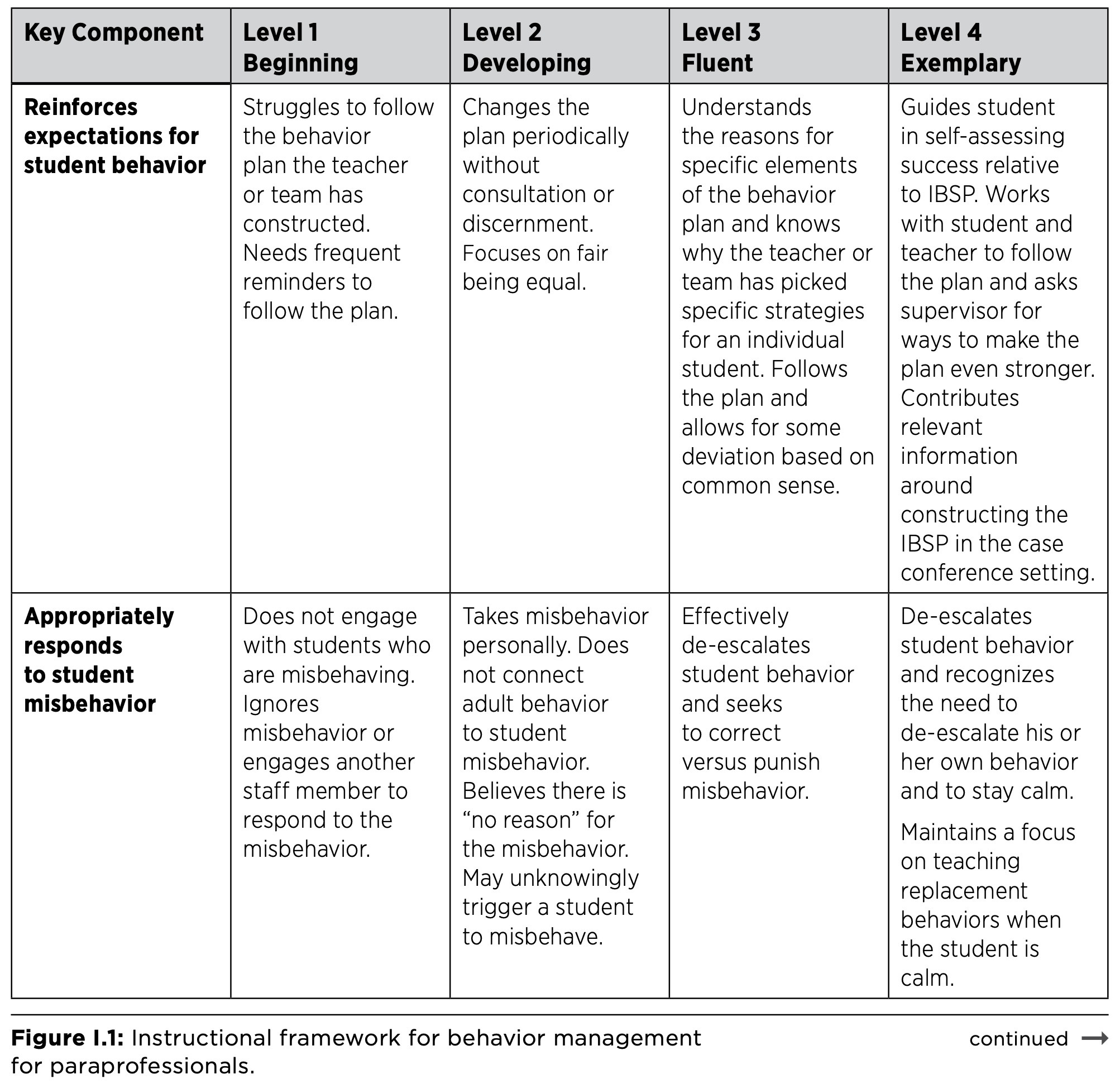
That distinction is the subject of an entire book, Mapping Professional Practice, written for exactly this reason: skilled coaches keep trying to do growth-level work with an evaluation-level tool, and the conversation stays shallow no matter how good the coach is.
A good framework, at any grain size, provides a growth pathway, not a judgment. Beginning, developing, fluent, exemplary—level one isn't a moral failing, it's just the start of the map.
A rubric used as an answer key turns "you're at level one" into a verdict, but the same rubric used as a map turns the same information into a location—a place someone is standing, with a visible next step from there.
And frameworks, done well, have to reckon with what Mapping Professional Practice calls invisible practice: the parts of teaching that never show up cleanly to an outside observer, because they live in planning, in judgment, in a hundred small trade-offs a teacher makes that nobody else in the building will ever directly witness.
A framework built only from what's easy to see will always undersell the practice it's trying to describe. The best frameworks take what the book calls the insider's view—describing what a practice actually feels like to the person doing it, not just what it looks like from the doorway.
Picture the conversation as a relationship between four things:
all connected to each other rather than flowing in one direction from evaluator to evaluated.
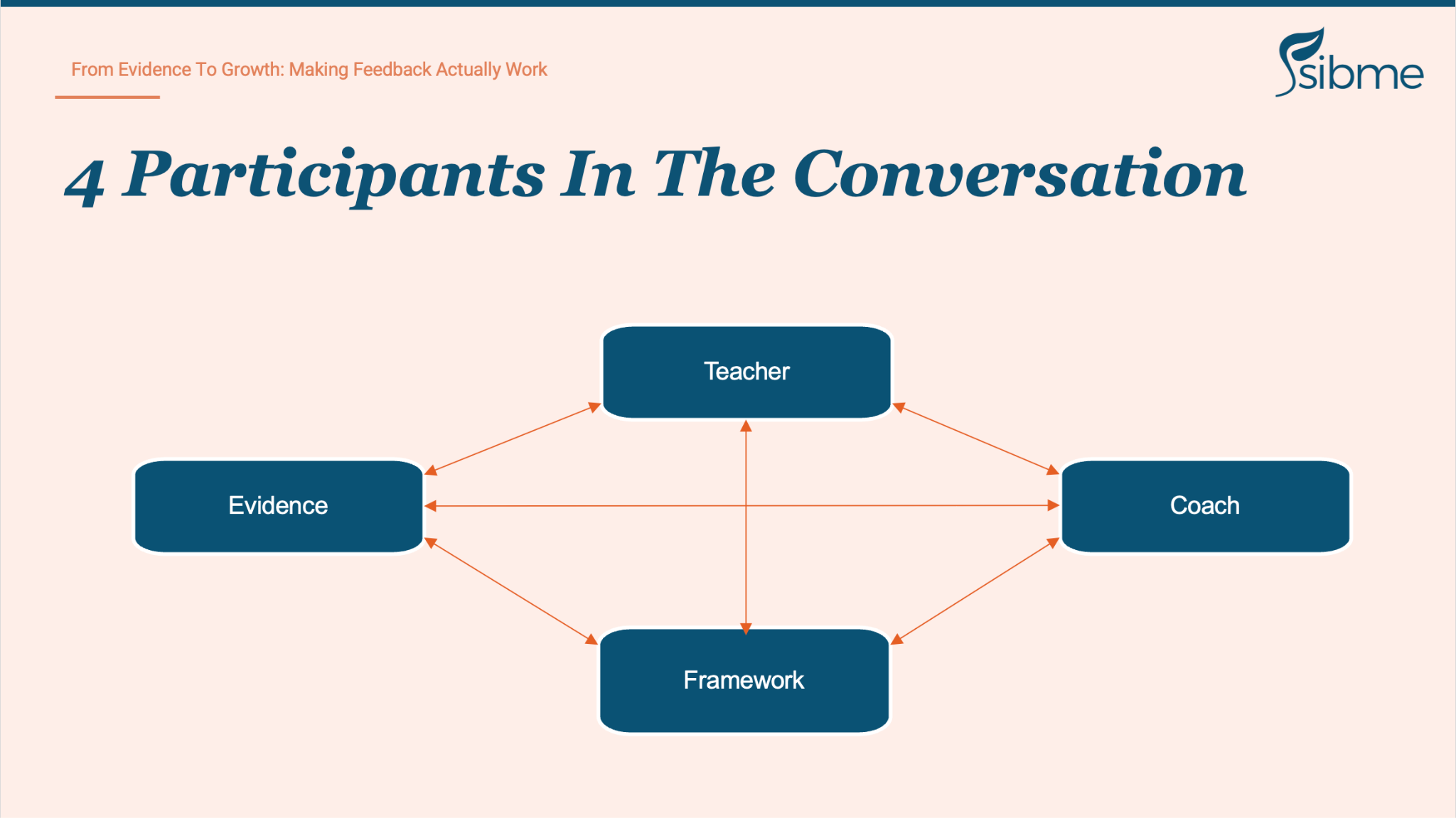
When a teacher brings their own evidence to the table—a lesson plan, a piece of student work, a reflection—something is revealed that couldn't be obtained any other way: what the teacher thinks good looks like. That's not bias. That's real, additional information about teacher thinking—information the coach couldn’t gather any other way.
Here’s where AI can be a useful tool. Rather than acting as an answer engine, AI can be a force-multiplier in curation and collation. Run a recorded lesson and its artifacts against a shared framework, and evidence comes back organized by criterion in seconds—faster than any human reviewing footage by hand could manage. (As we described in our first article, researchers usually allocate 8 hours for coding a 1-hour teaching video).
In one recent case, I (TJ) ran a report on an unfamiliar teacher's lesson kept citing the same three-minute clip as evidence across several different rubric dimensions at once—a moment easy to miss live, mid-note, mid-thought, with attention pulled a dozen directions at once.
The AI didn't know it was important in any deep sense. It just noticed the clip kept showing up, and that repetition was the signal. That's the job AI should be doing: surfacing what's there, fast and verifiably, so two humans can spend their limited time on the part that actually requires judgment—deciding what it means, and what to do next.
As we wrap up this 3-part series, let’s think of our work like tending a garden.
As educational leaders, we can’t make teachers grow. We can only create the conditions for growth.

Evidence is the soil—the raw material that makes growth possible at all. When leaders show up in classrooms, day in and day out, real growth can occur.
An instructional framework can, like a trellis, provide structure for growth. It can make it easy to grow in the right direction.
We can nurture and nudge, but we don’t produce the growth ourselves. As we illustrated in the Autonomy Matrix in Part 1, growth comes from high-attention, low-control leadership:
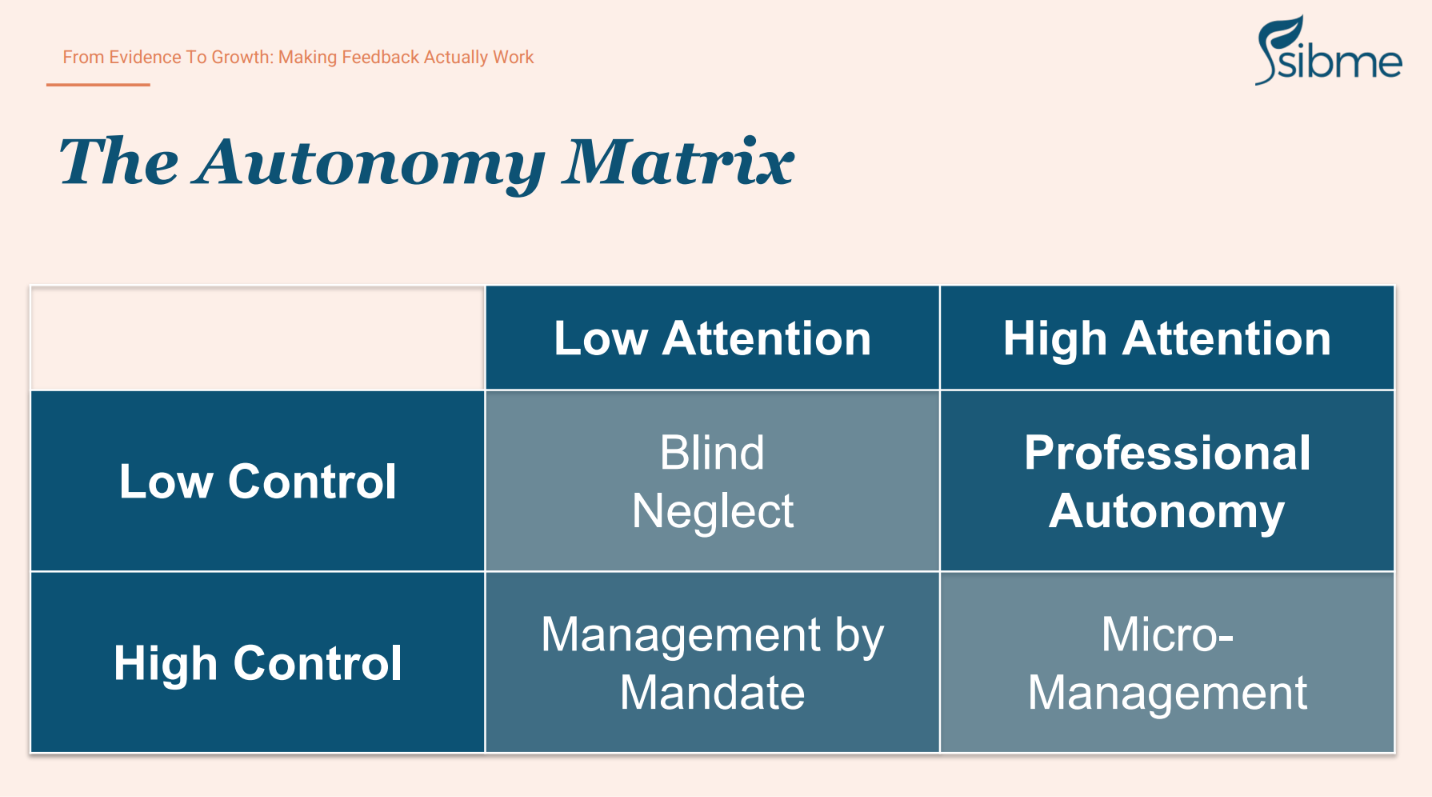
When teachers have the autonomy they need to do professional work, but aren’t left alone to figure everything out on their own, they can thrive.
It’s not a sign of respect to ignore people, trusting that they’ll do a good job. It’s a sign of respect to pay attention, to notice a teacher’s practice, and to engage in rich, rewarding conversations.
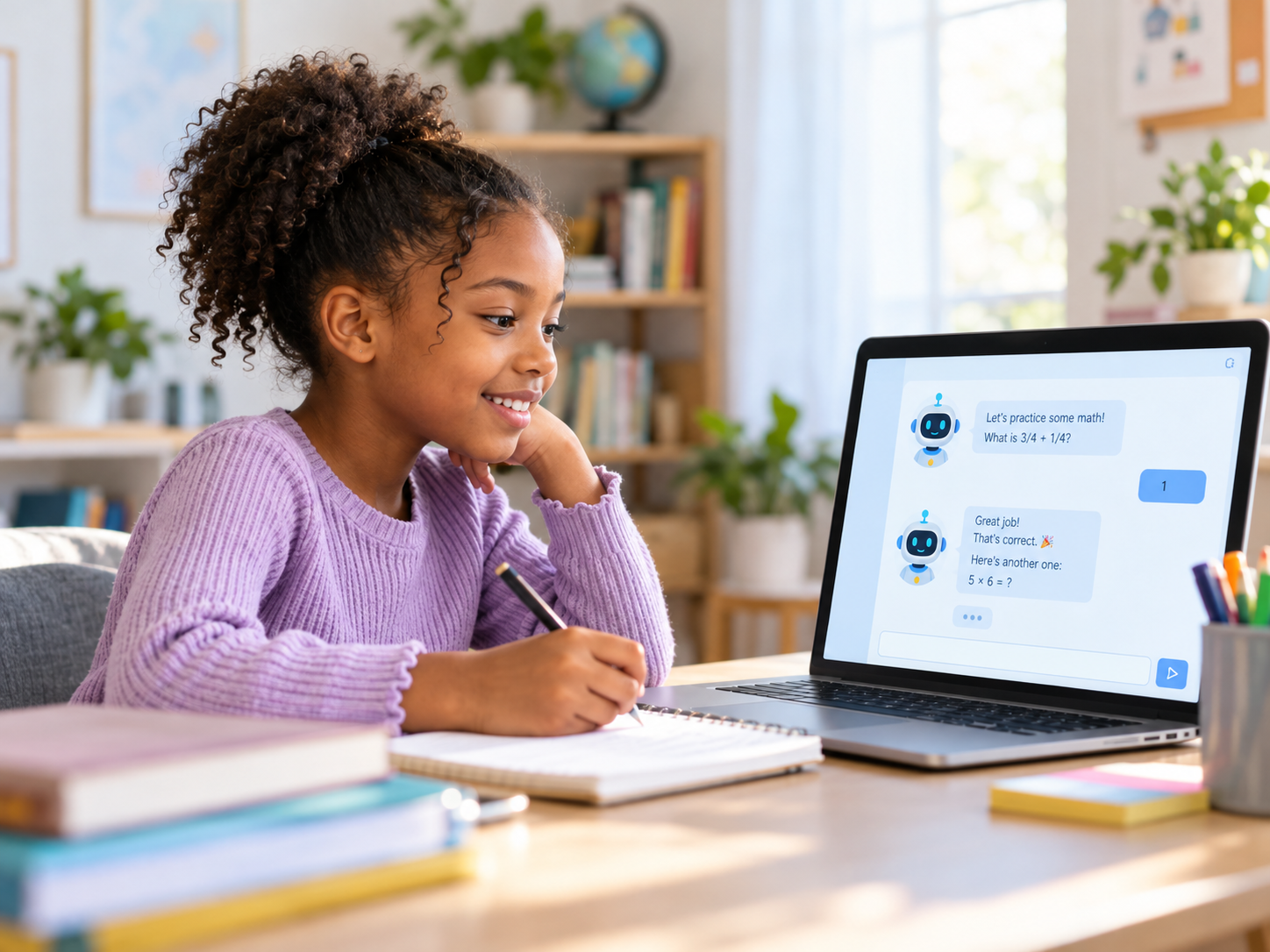
New research suggests the best AI tutors don't do the work for students. They create more chances for students to do it themselves, and catch the mistakes along the way.

The most valuable thing about an AI walkthrough isn't that it's smart. It's that it walked into the classroom with no history, no grudge, and no favorites. Here's how to make that work for you — without ever letting it off the hook.
.jpg)
While AI adoption is widespread in education, relying on AI detectors is failing and fueling an atmosphere of distrust. The deeper threat is "cognitive surrender"—where students lean on chatbots at the first sign of struggle—combined with a massive support gap for teachers who lack adequate guidance. Rather than policing students, the path forward involves focusing on active, observable learning processes, encouraging human connection, and giving educators collaborative tools like Sibme to reflect on and improve their teaching practice.
The instructional evidence platform for K–12 districts.