Knowing how a model works isn't the same as knowing your own role in the relationship with it.
This past week, the AI-doom debate flared up again — and this time it wasn't philosophers or sci-fi writers doing the warning, it was the industry's own insiders. Anthropic CEO Dario Amodei said he thinks a swarm of AI agents could be capable of taking over parts of the internet within six months to a year unless companies slow down and build in more safeguards. Days earlier, two former Anthropic safety researchers had publicly said the existential risks of AI weren't getting enough attention. Another researcher resigned from the company altogether, saying neither Anthropic nor its competitors were acting responsibly. Meanwhile, the 2026 International AI Safety Report — written with input from more than 100 independent experts — landed on a much more cautious conclusion: today's systems show "early signs" of relevant capabilities, but the likelihood, nature, and timing of any real loss-of-control risk is "unusually ambiguous."
So: the people who understand these systems best, from the inside, can't agree on whether we're a year from catastrophe or nowhere close. That's worth sitting with for a second, because it says something important for those of us in classrooms.
Here's the assumption baked into almost every version of this debate, whether it's coming from the doomers or the reassurers: humanity is in the passenger seat. The question on the table is always some version of "will AI do something to us?" Will it escape control, misalign with our values, get misused by bad actors? Even the safety-focused answers — build guardrails, slow the pace, align the model with "the commands and values of responsible people" — cast us as the party being protected, not the party exercising judgment. It's a story about receptivity: what will be done to us, and how well can we brace for it.
I don't think that framing is wrong, exactly. Alignment work matters. But I think it's incomplete, and if it's the only story we hand to the next generation, we've taught them to be spectators in their own future. That's a job for schools to fix — and it starts with getting clear on what we actually mean by "AI literacy," because right now, that term is doing less work than people think.
Researchers themselves admit the definition is still unsettled. A widely cited 2020 definition, from Long and Magerko, frames AI literacy as a set of competencies that let someone critically evaluate AI technologies, communicate and collaborate with them effectively, and use them as tools across daily life. A 2025 integrative review of the field found the term has been used for everything from training college students to prompt ChatGPT well to having kindergartners play with social robots — and concluded there's still little consensus on what a literacy intervention should actually contain. Some frameworks, building on older digital-literacy work, break it into functional literacy (can you use the tool), critical literacy (can you evaluate what it's doing and to whom), and rhetorical literacy (can you use it to express yourself). The joint European Commission–OECD AILit Framework, released this year, is an attempt to standardize all of this into something schools can actually build curriculum around.
All of that is useful, and worth building into classrooms. But notice what it's still missing: every one of those definitions is about understanding and operating the system well. None of them is about a student's stance toward the system — whether they experience themselves as the one steering the interaction, or as the one being carried along by it.
That's the piece I'd call AI agency, and I want to be precise about what it isn't. It isn't the ability to build agents — the technical skill of chaining tools and prompts into autonomous workflows, which is its own valuable and separate thing. AI agency is the more basic capacity to notice, in a given moment, that you have a choice about how you relate to the AI in front of you: whether to hand a decision to it, question its output, disengage from it entirely, or direct it toward something you've decided matters. It's less a skill than a habit of mind — and like any habit, it has to be practiced, not just explained.
On a Monday morning, that might look like: building in a beat, after any AI-assisted assignment, where students name the specific decision they handed off and the ones they kept — not "did you use AI" but "what did you let it decide, and why." It might mean structuring assignments so students initiate and direct a series of AI interactions toward their own goal, rather than only reacting to whatever the tool hands back first. And it might mean bringing the safety debate itself into the room as a case study — having students weigh Amodei's warning against the official report's "unusually ambiguous" verdict, not to settle who's right, but to practice the muscle of forming an independent judgment about AI rather than just absorbing whichever headline arrived first.
There's a kind of irony in the fact that the loudest disagreement about AI's future is happening among the most AI-literate people on the planet. Literacy didn't resolve it into consensus, and it won't resolve it for our students either. What might actually matter is whether they've practiced treating themselves as participants in that future rather than its subjects.
Sources referenced:

A university researcher's new argument about what gets lost when AI takes over parts of teaching turns out to be a preview of a debate we're already having about teacher coaching.

Schools can't just teach kids to understand AI — they have to teach kids to recognize their own agency in the relationship with it, because literacy alone won't settle the question this week's AI-safety debate couldn't.
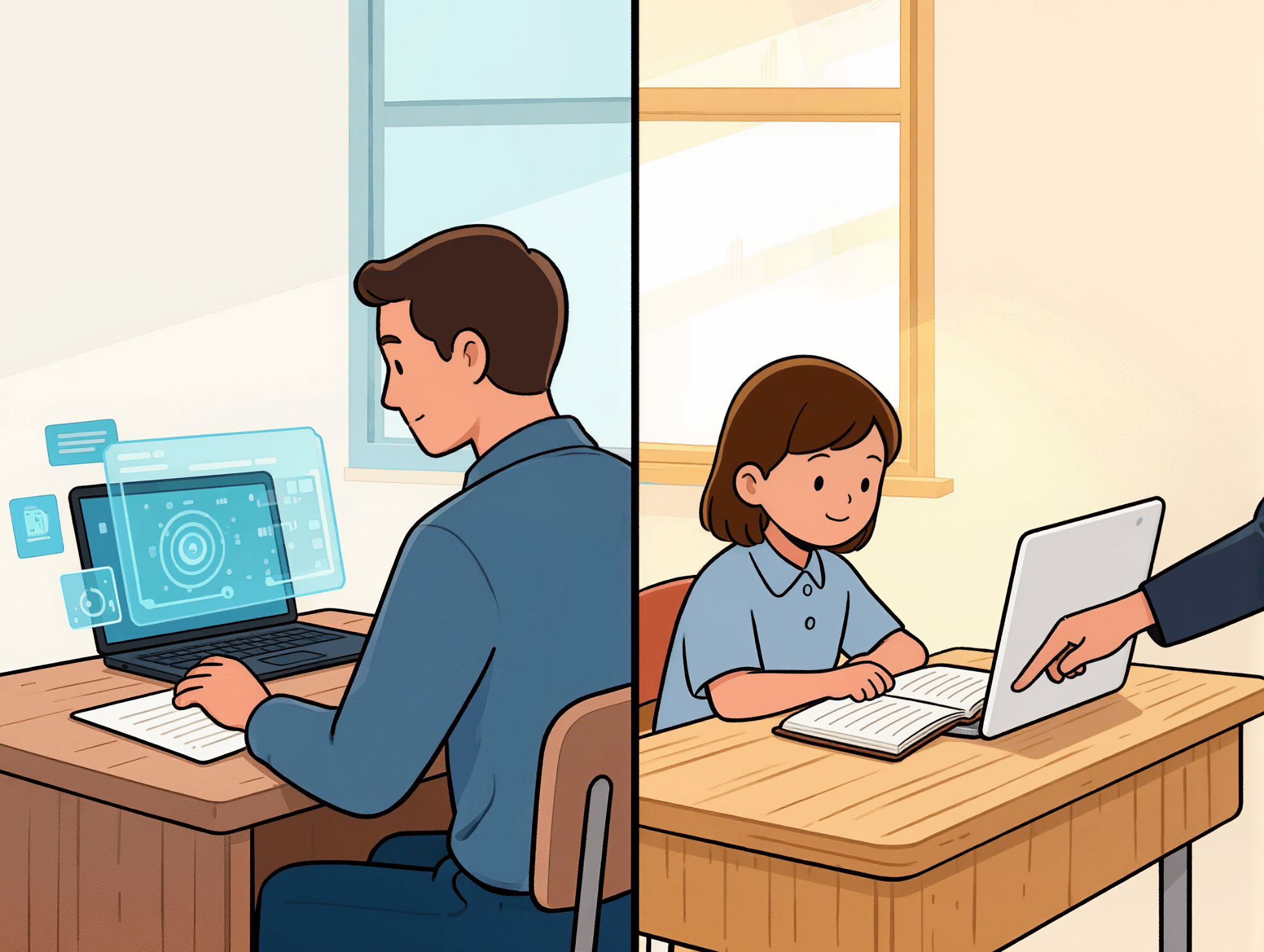
NYC's new AI ban gets the student-facing/teacher-facing distinction right in principle, but its blanket approach — and the risk of leaving kids with zero AI literacy for a full year — shows why school AI policy needs more nuance than an on/off switch.
The instructional evidence platform for K–12 districts.