The phrase is suddenly everywhere in AI news. Here's what it means, what's actually happening, and why it matters for those of us who teach.
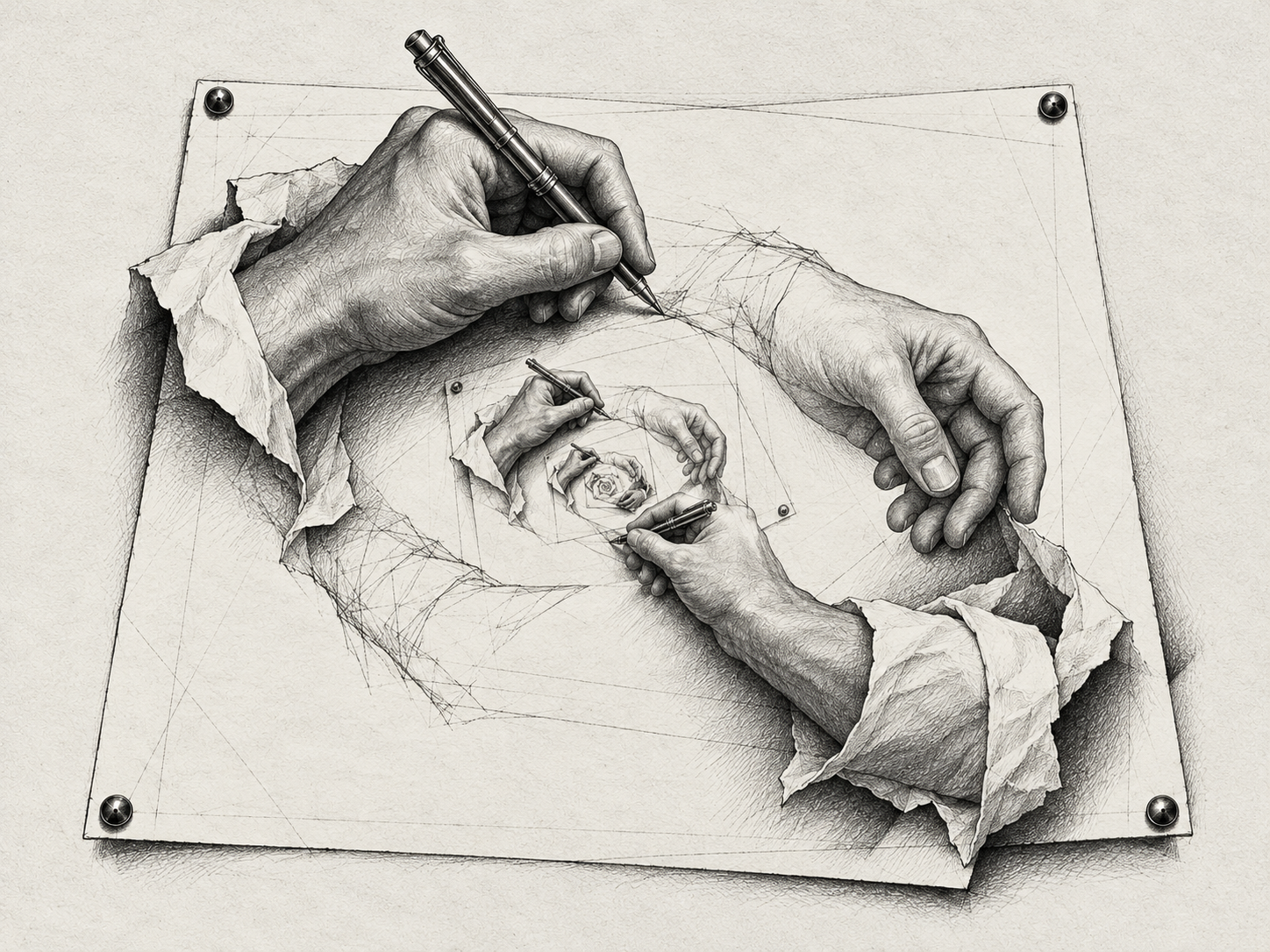
Think about the best student you've ever had. Not just the one who learned fast, but the one who got better at learning itself: they figured out how they study best, refined their note-taking, and each year arrived a little sharper at picking up the next thing.
Now imagine that student could also redesign their own brain. That, in a sentence, is the idea behind recursive self-improvement, and in 2026 it has moved from science-fiction speculation into the daily headlines.
Most AI today gets better because people make it better: engineers write code, gather data, run experiments. Recursive self-improvement (often shortened to RSI) is the idea that an AI system starts doing that work itself, helping build the next, more capable AI.
The "recursive" part is the key. If AI version 2 is better at AI research than version 1, it can build an even better version 3, which builds version 4 faster still. Each round of improvement makes the next round easier. That compounding loop is why the idea draws so much attention.
The idea isn't new. The mathematician I. J. Good, who worked with Alan Turing at Bletchley Park, described a possible "intelligence explosion" back in 1965. What's new is that people are now pointing to real systems.
A useful distinction: in its strict, original sense, RSI meant an AI rewriting its own inner workings. What's happening today is mostly looser, AI helping humans do AI research, and some writers argue the term is being stretched to cover it. Both versions point the same direction, but it's worth knowing which one a headline means.
The topic exploded this year after Anthropic reported that, as of May 2026, its own AI model, Claude, wrote more than 80% of the code merged into the company's production codebase. AI is now doing a large share of the work of building AI. OpenAI has said it sees early signs of RSI in today's systems and is aiming for a fully automated AI researcher by 2028, and new startups have raised hundreds of millions of dollars on the premise.
But there's real disagreement about how fast this goes. In August, MIT Technology Review covered research finding that AI agents still struggle with open-ended research: the free-form, judgment-heavy work with no clear right answer. AI improves fastest where success is easy to check automatically, like whether code runs. Choosing what to investigate, and having the taste to know a promising idea, is harder.
So the honest summary: the loop has started in a partial, human-supervised form. Whether it closes completely, and how quickly, is one of the biggest open questions in the field.
We don't need to become AI researchers to take something useful from this. A few thoughts for Monday morning:
Recursive self-improvement is neither pure hype nor a done deal. It's a real trend, AI doing more of the work of building AI, wrapped in real uncertainty about where it leads. That's a good place for educators to stand: curious, informed, and asking good questions. Our students will grow up in whatever this loop produces. Helping them think clearly about it may be one of the most important things we teach.
What questions are your students asking about how AI is made? I'd love to hear them.
This is part of Teaching in the Age of AI, a weekly digest of research and ideas for educators navigating AI in the classroom. Subscribe, follow, or share to get each week's post.
Think about the best student you've ever had. Not just the one who learned fast, but the one who got better at learning itself: they figured out how they study best, refined their note-taking, and each year arrived a little sharper at picking up the next thing.

New research suggests the best AI tutors don't do the work for students. They create more chances for students to do it themselves, and catch the mistakes along the way.

The most valuable thing about an AI walkthrough isn't that it's smart. It's that it walked into the classroom with no history, no grudge, and no favorites. Here's how to make that work for you — without ever letting it off the hook.
The instructional evidence platform for K–12 districts.