Pick a teacher on your roster. Any teacher.
Now think about everything you do to evaluate that person over the course of a school year. The pre-conference. The formal observations. The walkthroughs. The write-ups after each one. The post-observation conferences and the prep you do before them. The notes you take during those conferences so you have a record of what was said. The summative document you assemble from everything you collected. The final meeting.
Now multiply that by every teacher you evaluate.
If you've never actually added it up, the number is larger than you think. We're going to do it here, step by step, so you can see exactly where the time goes — and exactly where it doesn't have to.
The traditional observation cycle: one teacher, one year
Let's build the math from the ground up. These estimates are conservative. If your experience runs longer at any step, the case only gets stronger.
Pre-observation conference Scheduling coordination, the meeting itself, and notes captured afterward: roughly 1.25 hours.
Formal observations — two per year Each formal observation involves more steps than the in-classroom time suggests:
Per formal observation: ~3.75 hours. Times two: ~7.5 hours.
Informal walkthroughs — four per year
Per walkthrough: ~45 minutes. Times four: ~3 hours.
Summative evaluation
Summative total: ~3 hours.
Traditional model total: ~14.75 hours per teacher, per year.
At a 15-teacher evaluation roster, that is 221 hours annually — nearly six full work weeks — spent on observation paperwork, write-ups, meeting prep, and documentation. Every year. On top of everything else a principal does.
Most of that time is not spent in classrooms. It is spent at a desk, formatting notes into documents that will be read once, filed, and never connected to the coaching work happening in a separate system down the hall.
The Sibme evidence-first model: same teacher, same year
Now let's run the same math with Sibme's Observations module. Same evaluation requirements. Same number of touch points. Different tools doing different work.
Pre-observation conference The process template is already built in Sibme. The teacher's existing goals carry forward from her workspace. Scheduling happens in the platform. The meeting is recorded — or notes are typed live — and Sibme AI generates a structured summary automatically. Both the observer and teacher have access to the record.
Observer time: ~45 minutes. Saves ~30 minutes versus traditional.
Formal observations — two per year
In-classroom time is the same — that doesn't change. What changes is everything that happens after the observer leaves the room.
Sibme's Synced Notes captures the observer's typed notes on her laptop in real time while simultaneously recording video on her mobile device. When the observation ends, the notes are automatically anchored to the corresponding moments in the video timeline. There is no separate organization step. There is no reformatting. The structured record is produced during the observation itself.
From those synced notes, Sibme AI generates a draft feedback summary — rubric-aligned, organized, ready for the observer to review and edit. That review takes 10–15 minutes, not 60–90.
Post-observation conferences are recorded or live-noted the same way as the pre-conference. AI summarizes. Both parties have access. No post-meeting write-up required.
Per formal observation: ~1.75 hours. Times two: ~3.5 hours. Saves ~4 hours versus traditional.
Informal walkthroughs — four per year
Synced Notes is where walkthrough time collapses most visibly. The observer walks in, opens Sibme on her mobile device, records and scripts simultaneously. When she walks out, the record is already built. Sibme AI generates a brief summary. She reviews and submits in 5–8 minutes.
Per walkthrough: ~30 minutes. Times four: ~2 hours. Saves ~1 hour versus traditional.
Teacher-contributed evidence — reviewed with AI Copilot
This is the step that has no equivalent in the traditional model. Throughout the year, the teacher submits evidence directly into her observation record — video clips, lesson plans, student work samples, coaching artifacts, whatever documents her practice in relation to her goals. The observer doesn't have to schedule a classroom visit to collect this evidence. It arrives.
And the observer doesn't watch or read all of it manually. She opens the evidence portfolio in Sibme — selecting multiple submissions at once — and asks Sibme AI Copilot where to look. The Copilot analyzes the full body of evidence and surfaces the moments and materials most relevant to the rubric indicators being evaluated. If a teacher submits four video clips, the observer isn't watching forty minutes of footage. She's watching the eight to ten minutes the Copilot flagged across all four clips combined.
Observer time for reviewing a full year of teacher-submitted evidence with Copilot: ~20 minutes. This is new time on the evidence-first side — but it replaces multiple classroom visits the observer would otherwise have needed to conduct to collect equivalent evidence herself.
Summative evaluation
By the time the summative conference arrives, Sibme has been organizing and connecting evidence all year. The observer doesn't assemble the record — it's already assembled. She asks Sibme AI Copilot to surface patterns across the full portfolio: what the evidence shows about growth, where the strongest indicators are, where gaps remain. Reviewing those AI-generated insights takes 10–15 minutes, not 30–45.
The summative narrative is drafted by AI from the full-year evidence record. The observer reviews and edits: 15–20 minutes versus 45–60 for a manual write-up. The conference is recorded and summarized automatically. Filing happens in the platform.
Summative total: ~1.25 hours. Saves ~1.75 hours versus traditional.
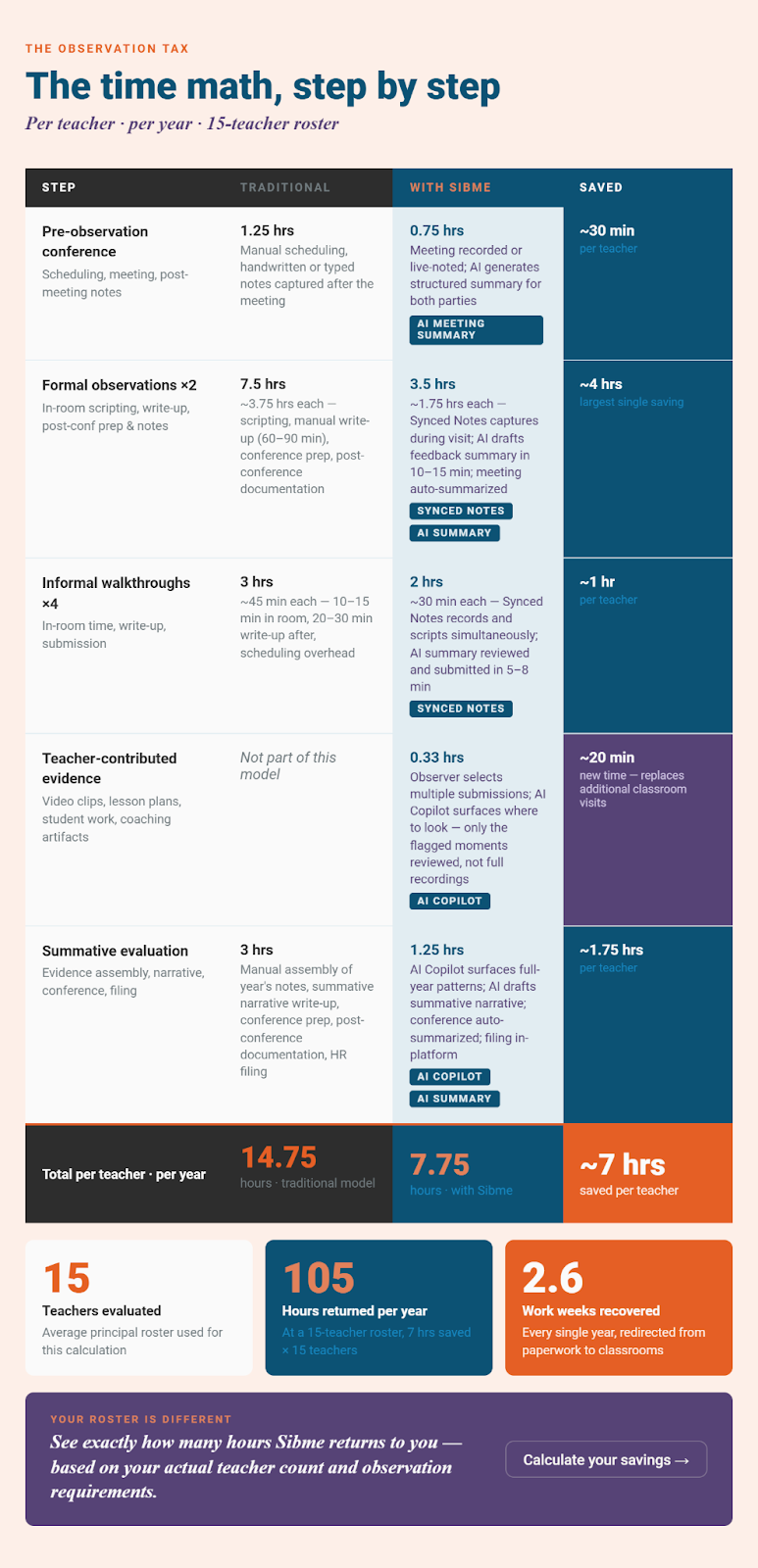
7 hours saved per teacher. Per year.
At a 15-teacher roster: 105 hours returned — nearly three full work weeks every year that were previously absorbed by formatting, filing, reconstructing, and documenting. Time that can go back to classrooms, coaching conversations, and the observations themselves.
That is not a minor efficiency gain. It is a structural shift in how a principal's time is allocated across an entire school year.
What does your roster look like?
Every building is different. Fifteen teachers is a starting point — your number may be higher, your observation requirements may vary, and your current write-up time may already be running longer than the conservative estimates above.
Use Sibme's Time Savings Calculator to run the math on your actual roster. Enter your teacher count, your district's observation requirements, and how long your write-ups typically take. The calculator will show you exactly how many hours Sibme returns to you — and what you could do with them instead.
Sibme's Observations module launches July 2026. Synced Notes, AI Copilot, and meeting summarization are core features of the module at launch. Learn more at sibme.com/observations.
.jpg)
While AI adoption is widespread in education, relying on AI detectors is failing and fueling an atmosphere of distrust. The deeper threat is "cognitive surrender"—where students lean on chatbots at the first sign of struggle—combined with a massive support gap for teachers who lack adequate guidance. Rather than policing students, the path forward involves focusing on active, observable learning processes, encouraging human connection, and giving educators collaborative tools like Sibme to reflect on and improve their teaching practice.
A university researcher's new argument about what gets lost when AI takes over parts of teaching turns out to be a preview of a debate we're already having about teacher coaching.

Schools can't just teach kids to understand AI — they have to teach kids to recognize their own agency in the relationship with it, because literacy alone won't settle the question this week's AI-safety debate couldn't.
The instructional evidence platform for K–12 districts.