Post 3 of 5 in The Coaching Intelligence Series
By Dr. Tammy Thompson Kapp and Kelley L. Garris
There's a version of instructional coaching that most schools are running right now. An observer schedules a time, walks into a classroom, takes notes for forty-five minutes, and delivers feedback a few days later. Then the cycle resets. The next observation starts fresh — same coach, same teacher, but almost no connective tissue between what happened last time and what's happening now.
This model is familiar. It's also, based on what the research shows, not really coaching at all.
The studies that demonstrate coaching's remarkable impact on teacher practice and student achievement weren't studying episodic observation. They were studying sustained, relationship-based, evidence-informed cycles — ones where the coach knew the teacher's goals, understood their growth trajectory, and showed up to each conversation with real context rather than a blank notepad. That's a fundamentally different activity. And the gap between the two explains a lot about why so many coaching programs fail to deliver what the research promises.
The traditional cycle has a structural problem at its core: it treats the observation as the unit of coaching. One event. One set of notes. One feedback conversation: which is often delivered days after the moment it was relevant. Then repeat, maybe once a month, maybe less. Teachers experience this as episodic, disconnected, and, if they're being honest, not that different from the evaluation process they were told coaching was separate from.
What the research actually calls for is a cycle built around continuous evidence rather than disconnected events. A teacher's growth doesn't happen in a single observation. It happens across goals set in September that are still in view in March. It happens in the accumulation of patterns across multiple cycles — patterns that no single observation can reveal. It happens in student work, in lesson artifacts, in the coaching conversations themselves. Great teaching leaves evidence everywhere, all the time. The question is whether the coaching model is designed to use it.
The evidence-first model changes the unit of measurement. Instead of a single observation snapshot, one moment captured through one lens and filtered through a coach's memory and notepad, it builds a multi-modal portfolio over time. Videos. Lesson plans. Student work samples. Goal records that persist across the school year. Coaching notes that connect to each other rather than sitting in isolation. When that portfolio is the foundation of every coaching conversation, the conversation stops being a report and starts being a genuine examination of a teacher's practice in full.
Redesigning the cycle around that premise changes everything, not just what coaches do during an observation, but what they do before it, after it, and between cycles. It also changes what's possible in terms of scale and frequency. It also changes what's possible in terms of scale and frequency. In the traditional tech-free model, a single coaching cycle, which spans goal-setting through observation through feedback, consumes somewhere between two and three hours of a coach's time. Most of that has nothing to do with the teacher. It's the documentation tax: reconstructing context from old notes, organizing what was observed, drafting feedback from scratch, tracking down the goal that was set six weeks ago.
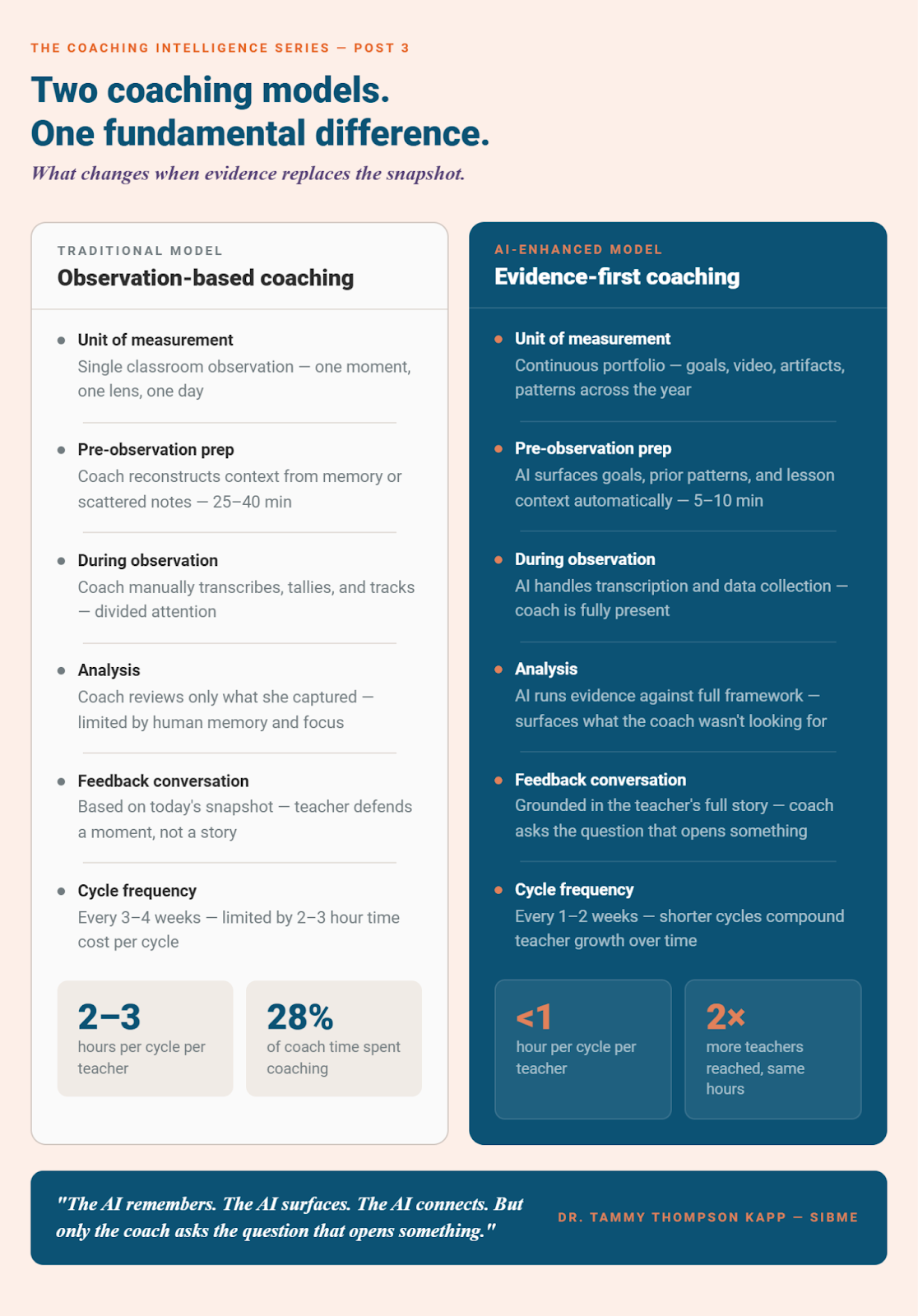
That's where AI-enhanced coaching fundamentally shifts the calculus. When an AI tool handles the documentation — transcribing what happened, surfacing patterns across previous cycles, connecting this observation to the teacher's stated goals, flagging evidence against rubric criteria — coaches recover the one resource that can't be manufactured by scheduling optimization alone: attention.
The time comparison is striking. A traditional cycle runs two to three hours. An AI-enhanced cycle, where the platform surfaces context automatically and drafts pattern summaries for the coach to review and edit, can run under an hour — with the majority of that time spent in the actual coaching conversation. That's not a marginal efficiency gain. That's the difference between cycling back to a teacher every three to four weeks and cycling back every one to two weeks. And the research is clear about what that frequency difference means for teacher growth: more frequent, shorter feedback loops compound over time in ways that monthly episodic coaching simply cannot.
There's another dimension to this that often goes undiscussed. Every coach who has ever sat down to write feedback has faced some version of the same problem: you noticed what you noticed, but you can't notice everything. Your attention was on student engagement, so you may have missed the questioning patterns. You were focused on the lesson structure, so the wait time data didn't register. This isn't a failure of skill — it's a feature of human attention. We can only hold so much in working memory at once.
AI doesn't have that constraint. When a coaching platform can simultaneously run a lesson transcript against every criterion in a teacher's evaluation framework — flagging what the coach might not have been looking for, surfacing patterns the human observer didn't have bandwidth to track — it answers the question coaches can never fully answer alone: what am I not thinking of? That's not the AI making judgments. It's the AI generating possibilities for the coach to examine, accept, or set aside. The judgment stays human. The range of what gets considered expands dramatically.
This is the division of labor that makes AI-enhanced coaching work: AI handles what is computationally intensive and low-stakes — transcription, pattern analysis, framework-matching, context surfacing, documentation. Humans handle what is irreplaceable and high-stakes — the feedback conversation, the goal-setting, the relationship, the professional judgment about what this particular teacher is ready to hear right now. Neither does the other's job. But each makes the other's job better.
The conversation is still the whole point. Every efficiency gained, every documentation burden reduced, every minute recovered from the administrative margins of the coaching cycle — all of it exists to protect and enrich the moment when a coach and a teacher sit down together. That's where growth happens. It happens better when the coach arrives prepared, when the teacher feels genuinely known, and when the feedback is grounded in a story both of them have been building together — not a snapshot either of them will forget by next week.
We asked Dr. Tammy Thompson Kapp, Executive Director of Virtual Coaching at Sibme, and Kelley Garris, Lead Virtual Coach at Sibme, to reflect together on what this shift (from observation-based to evidence-first coaching) looks like in practice — Tammy asking Kelley what the work looks like from the ground level with the coaches she supports, and Kelley turning the questions back to Tammy about what she'd do differently as a school leader. Here's that conversation.
Tammy: Kelley, I want to start with something practical. In your role as Lead Virtual Coach at Sibme, you're supporting other coaches through a full coaching cycle — using our A2RISE framework to guide the work. When you think about the coaches you work with, what’s the moment where the traditional cycle breaks down most visibly? Where do they feel it the most?
Kelley: When the coaches I support reflect back to me, one of the biggest moments they name is right before they walk in to observe a teacher. They're rushing. They're trying to get their notes together, get their computers open, remember what the last observation was, remember what that particular teacher's goal was. And they can feel a little rattled walking in. There's a lack of fluidity to it, and that's the pain point that keeps surfacing in our conversations.
I empathize with that completely. When I was in school coaching, I felt that same lack of fluidity—wearing a million hats, trying to stay present while juggling goals, priorities, and everything in between. It's hard to do any of it well when you're doing all of it at once. So when the coaches I support tell me they feel that way, I understand it from the inside.
Tammy: That's such an honest way to put it. And what you're really describing is a cognitive load problem — everything an instructional coach has to juggle when they step into that role, and then the documentation piece sitting on top of all of it. Not a burden exactly, but a real part of what the work requires.
So when the coaches you support start working with tools that surface that context automatically — the goals, the prior observations, the patterns — what do you see change for them?
Kelley: I see a greater presence. The focus becomes being present, and I think that's the greatest gift we can give educators when coaches walk into their classrooms. The cognitive load piece gets reduced significantly because everything you need is right there on the screen. The video is recording so I could watch it back again if I wanted. The goal is already on the screen. The lesson plan is available to me. I can see coaching notes from previous conversations. Everything is at your fingertips, and because of that, you can actually be present — in your mind and in your body. I can pay attention to details and take-in the fullness of the experience instead of being merely the manager of my notes.
That's something I talk about a lot with the instructional coaches I work with: what it means to be fully present. And honestly, thinking back to my own time as a coach on the ground, I would have loved that. I think I would have been a stronger coach, more focused, if I'd had the kind of support that our Sibme AI features and platform provide.
Tammy: And the AI doesn't just reinforce what you're already looking for, does it? It stretches it — beyond what you had your eye on going in.
Kelley: Exactly. Say, hypothetically, I'm going into a classroom as a coach working with a teacher on student discourse. That's where my attention is. But if we’re recording the observation, our AI Report and Insights may highlight some things that I was not explicitly tracking like teacher language complexity or questioning patterns.
AI is not telling me what is more important. It just gives us more to consider. And because I'm fully present in the room — because the AI is handling the documentation — I get to decide whether any of it is worth discussing. Our AI features make sure I have the full picture to draw from.
Tammy: I love that framing, because it goes right to what's different about the feedback conversation itself. And I want to stay with that for a minute, because I think there's another piece to it that matters.
The coaches you support aren't just working from video. At Sibme, we think about coaching holistically — almost like we’re telling a story. So when you move through a coaching cycle with an instructional coach or leader and their volunteer teacher, using the A2RISE framework to anchor the work, you're bringing in more than just the observation. What does that look like?
Kelley: That's right. We believe video can be the anchor, but it's not the whole picture. We encourage a cycle that brings in lesson plans, formative assessments, student work, instructional materials, and reflections and we're being increasingly intentional about that, because our AI Insights make it possible. We can paint a richer picture of each teacher and the journey they're on with their students.
Our seven-week cycle gives coaches an opportunity to work with a volunteer teacher, which is a snapshot of what evidence-based coaching can look like over time. You can't build a complete story from a snapshot alone, but we're setting the tone: showing coaches that this is a journey that extends well beyond video, and one that deepens with frequency. When cycles happen every week or two instead of once a month, the conversations get lighter and more honest. Teachers aren't bracing for a big assessment. They're having a check-in with someone who already knows where they are. That rhythm changes the trust dynamic entirely. It's a fuller picture, and a steadier cadence, that coaches can carry forward with their teachers throughout the year.
Tammy: Okay, one more question before I turn it over to you. If you could name one thing that AI does in the coaching cycle that coaches simply cannot do as well on their own, what would it be?
Kelley: Honestly? Having a thought partner, one grounded in data. That's what I keep coming back to.
I like having something beside me that can show me patterns I’d miss on my own and make me say, "I never thought of it that way." It’s not opinion. It’s pulling from what actually happened in a classroom, in the evidence, in the work. I like having that available when I need it -to lean into, to use, or not. But it's there. And sometimes it does change my thinking,
Tammy: And I'd add to that — the AI can generate multiple options to consider. As humans, we naturally gravitate toward familiar ways of thinking. The AI can offer different perspectives and possibilities we might not have thought about or reached on our own, and I love that! It stretches how we think about the work.
Kelley: Yes. That's exactly it.
Kelley: Alright, Tammy — my turn. You spent years as a campus and district leader before moving into your work here at Sibme. When you think about the coaches you had in your buildings, what do you wish you had done differently to support them?
Tammy: My coaches were doing so many of the things we'd hope to see from effective coaching. They were in classrooms. They were observing teachers. They were providing feedback. They were using look-fors. They were committed and they were skilled at what they were doing. They protected their time and coaching was their top priority. I surrounded myself with people who shared the vision I had about instructional leadership, and I took that role very seriously myself.
There was one thing we weren't doing as well as we could have, and I've come to see it more clearly since getting to Sibme: helping teachers genuinely reflect on their instructional practice. We were quantifying things. We had our walkthrough tool and we’d go into classrooms and see turn-and-talks, engagement strategies and all the things we worked on collaboratively with our teachers that were indicators of strong instruction. We quantified it and then we admired the data. We knew good things were happening. We just couldn't always tell when and where they were happening in a way that let us connect practice to impact. We couldn't point to a specific moment and say, "Teacher, here's what you did, and here's what happened right after." We had the vision and the human resources. What we didn't have were the non-human resources , the tools, to make that vision fully realized.
Kelley: So there was a gap — but it wasn't a gap in commitment or skill. It was a gap in what the tools could do for the people doing the work.
Tammy: Exactly. And I think about this a lot, because the research on principal behavior being one of the strongest predictors of how much real coaching happens is a finding I took seriously as a principal. I knew I needed to be an instructional leader, in fact it’s the main reason I became a principal. My teachers knew that about me. I didn't feel under-resourced in the way some leaders describe, because I had surrounded myself with strong people. I didn't know what I didn't know. There was another layer to this work that the right tools could unlock.
Kelley: So knowing what you know now — what would you put in place?
Tammy: We already protected instructional time in very intentional ways. Students weren't pulled out of instruction for non-essential things. Support staff pushed into classrooms so every student had access to core content.
What I'd add now is the AI-enhanced coaching piece. If my coaches had been able to walk into reflective conversations with objective, robust data, video they could return to, alongside lesson plans, student work, and formative assessments, that would have been a game changer. Not because my coaches needed to be more committed or more skilled. They didn't. But because the conversations they were already having with teachers could have been grounded in something more than memory and notes.
And that evidence wouldn't have lived only in the coaching relationship. It could have moved into our PLC meetings and our instructional leadership team meetings — feeding the instructional vision and the continuous improvement plan we'd already built around strong instruction and student outcomes. All of the pieces we were committed to, we finally would have had a way to monitor over time and actually see the story unfold.
Kelley: That's the piece I think gets missed in a lot of conversations about AI in coaching. It's not a replacement for what skilled coaches are already doing. It's a way to let the work they're already doing become evidence-based in a deeper way than was possible before.
Tammy: That's exactly it. When we know better, we do better. What I know now is that the best thing I could have added for coaches who were already doing the work well was a way to extend their capacity. Even when coaching is the priority, and it was, my coaches were still supporting teachers and students in a number of different ways, as coaches typically do. Their commitment wasn't the limit. Human capacity was. Asking them to also hold every observation, every pattern, every goal across every teacher in their own memory is a weight no coach should have to carry alone.
The coaching was never what was missing. The conversation between a coach and a teacher is still the whole point. What AI does is carry the documentation so that the conversation, and the relationship behind it, can finally have everything it needs to work with.
Kelley: Building on something instead of starting over. That's still the whole redesign in one sentence, and it works for the coaches I support now just as much as it would have worked for the ones you had in your buildings then.
The difference now is that we have real tools that make it possible.
The next post in this series takes on the question we've been circling around: what is the uniquely human work in a coaching relationship, and what does it take to protect it? Because the answer to that question is the whole point of everything we've been building here.
.jpg)
While AI adoption is widespread in education, relying on AI detectors is failing and fueling an atmosphere of distrust. The deeper threat is "cognitive surrender"—where students lean on chatbots at the first sign of struggle—combined with a massive support gap for teachers who lack adequate guidance. Rather than policing students, the path forward involves focusing on active, observable learning processes, encouraging human connection, and giving educators collaborative tools like Sibme to reflect on and improve their teaching practice.
A university researcher's new argument about what gets lost when AI takes over parts of teaching turns out to be a preview of a debate we're already having about teacher coaching.

Schools can't just teach kids to understand AI — they have to teach kids to recognize their own agency in the relationship with it, because literacy alone won't settle the question this week's AI-safety debate couldn't.
The instructional evidence platform for K–12 districts.