Picture a tutorial where a student asks a confused, slightly-off-base question. A good instructor doesn't just answer it — they clock that three other students in the room probably have the same confusion, and they adjust the next ten minutes of the lesson accordingly. That's the work of teaching, and it happens in a fraction of a second, over and over, all day.
It's also the kind of moment that gets eliminated when a chatbot stands in for a teacher.
That's the core of a piece published this month on Phys.org, written by an education researcher responding to real developments on Australian campuses. Macquarie University recently introduced an AI chatbot called "Virtual Peer" into two psychology units, handling material that used to be taught live over Zoom. The researcher's argument isn't that AI has no place in a course — it's that education is more than information transfer, and something specific gets lost when a human isn't the one doing the teaching.
The researcher calls that something "recognition." When a student's question or a piece of feedback comes from a human educator, it does two things at once: it helps the student, and it signals to them that their thinking is worth taking seriously. A chatbot can answer the question. It can't (yet) notice that the question reveals a gap in the whole class's understanding, or that this particular student has been quietly making progress for three weeks and this is the moment to say so out loud. That's judgment, and judgment requires someone who's actually paying attention to a person, not just processing a prompt.
We think that's right — and Idon't think it's an argument against AI in classrooms. It's an argument about where AI belongs in the loop.
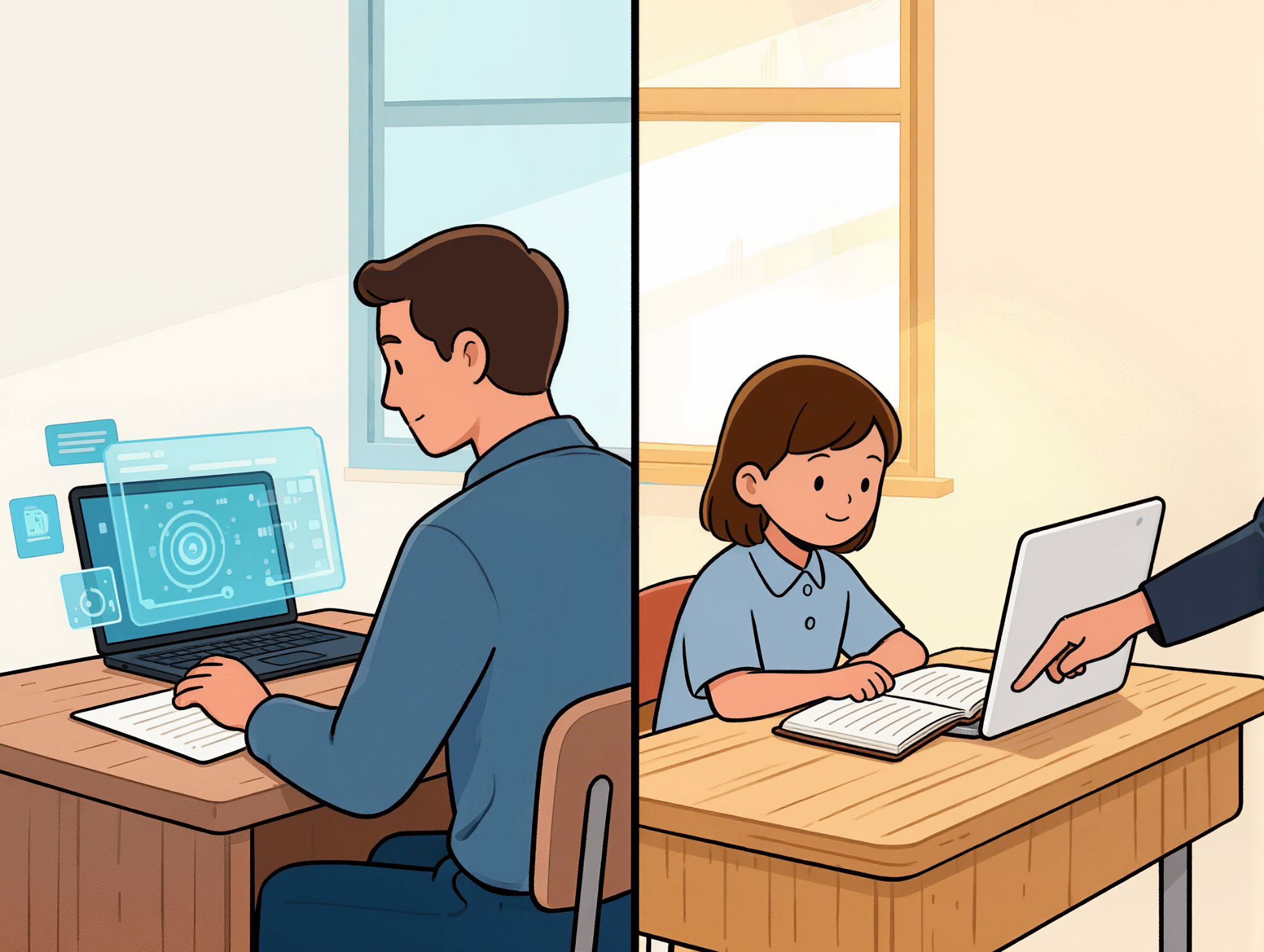
The mistake would be putting AI directly between students and new material, unsupervised, and calling it teaching. Students encountering something new need a human who can tell the difference between a productive struggle and a genuine misunderstanding, and who can adjust on the fly. That's not something we should hand off yet, and probably not ever.
But there's a second half to this that the "recognition" framing doesn't fully get to: the reason teachers have less capacity for that kind of moment-to-moment judgment than they'd like is that they're drowning in volume. Dozens of students, hundreds of data points, a whole semester's worth of assignments and exit tickets and half-finished sentences — there's more raw information coming at a teacher than any one person can actually process, let alone process well. If AI's real strength is speed and pattern-recognition across huge amounts of material, then the answer isn't AI instead of the human judge. It's AI clearing the noise so the human has more attention left to actually judge.
We've been making almost exactly this case on the coaching and observation side, and it's worth borrowing the logic. In a recent piece on evidence-first observation, Justin and TJ point out that the reason rich, unstructured evidence have never really caught on in teacher observation is that turning raw artifacts into usable insight used to take hours of manual transcribing and coding per hour of classroom instruction. AI changes that math — not by scoring the lesson, but by doing the grunt work of transcription and pattern-spotting almost instantly, so the observer's attention goes toward the part only a human can do: sitting with a teacher and asking the kind of specific, evidence-first questions that actually build judgment. Read the full piece here.
That's the same shape of answer for the classroom. AI isn't ready to be the one deciding whether a student's confusion needs a full re-teach or a two-sentence nudge. But it's already good — and getting better — at surfacing the pattern that makes that decision possible in the first place: which students are stuck on the same thing, which piece of feedback keeps recurring across a stack of essays, where the gap actually is. Handled well, that's not a threat to the teacher's role. It's the thing that gives the teacher enough bandwidth to actually play it.
So the useful question for any school or university rolling out an AI tool isn't "does this replace a human interaction?" It's "does this free up a human's attention for the interactions only they can have?" Those are very different products, and right now, they get marketed as though they're the same thing
Read more in this post

A university researcher's new argument about what gets lost when AI takes over parts of teaching turns out to be a preview of a debate we're already having about teacher coaching.

Schools can't just teach kids to understand AI — they have to teach kids to recognize their own agency in the relationship with it, because literacy alone won't settle the question this week's AI-safety debate couldn't.
NYC's new AI ban gets the student-facing/teacher-facing distinction right in principle, but its blanket approach — and the risk of leaving kids with zero AI literacy for a full year — shows why school AI policy needs more nuance than an on/off switch.
The instructional evidence platform for K–12 districts.