By TJ Hoffman
Picture a surgeon who reads every medical journal published in her field. She attends the top conferences. She has completed every available training module, sat through every seminar, and could lecture for an hour on the latest techniques in her specialty.
She has never actually performed a surgery.
Would you let her operate on you?
Of course not. And yet — every year — we ask teachers to improve their practice through professional development that works almost exactly this way. We hand them research summaries, walk them through slide decks, explain what best practice looks like, and send them back to their classrooms. Then we wonder why nothing changes.
Here's the thing. It's not that teachers aren't trying. It's not that the research isn't good. It's that information transfer and behavior change are two completely different things — and we've been confusing them for decades.
In 2018, Matthew Kraft, David Blazar, and Dylan Hogan published what remains the most rigorous causal analysis of instructional coaching ever conducted. Their meta-analysis, published in the Review of Educational Research, examined 60 studies — including randomized controlled trials — and what they found should have permanently changed the way schools think about professional development.
Coaching produced an average effect of 0.49 standard deviations on measures of instructional quality and 0.18 standard deviations on student achievement. The instructional effect, to put it plainly, was equivalent to the growth a teacher typically accumulates over five to ten years of classroom experience. Compressed into a single coaching engagement.
That's not a small finding. That's transformational.
But here's what I find even more compelling. Kraft and his colleagues didn't just measure coaching against a control group — they measured it against everything else. Student incentive programs. Pre-service training. Merit pay. General professional development. Data-driven instruction. Extended learning time. Coaching outperformed all of it.
If you're an instructional coach and someone asks you to justify your role, this is where you start.
Here's the problem: "instructional coaching" has become a label that gets slapped onto almost anything.
A principal pops into a classroom, catches five minutes of a lesson, offers a comment in the hallway on the way out. Coaching. A curriculum specialist meets with a team once a semester to review pacing guide alignment. Also coaching. A teacher watches a recorded webinar and answers three reflection questions. Coaching.
None of that is what Kraft, Blazar, and Hogan were studying.
The programs that produced those effect sizes had specific things in common. Desimone and Pak (2017), synthesizing findings across multiple studies, identified the defining features: a consistent focus on content and pedagogical practice, structured observation and feedback cycles, sustained engagement over time — not one-time events — and a relationship built on trust, confidentiality, and shared professional purpose.
Notice what's in that list. And notice what isn't.
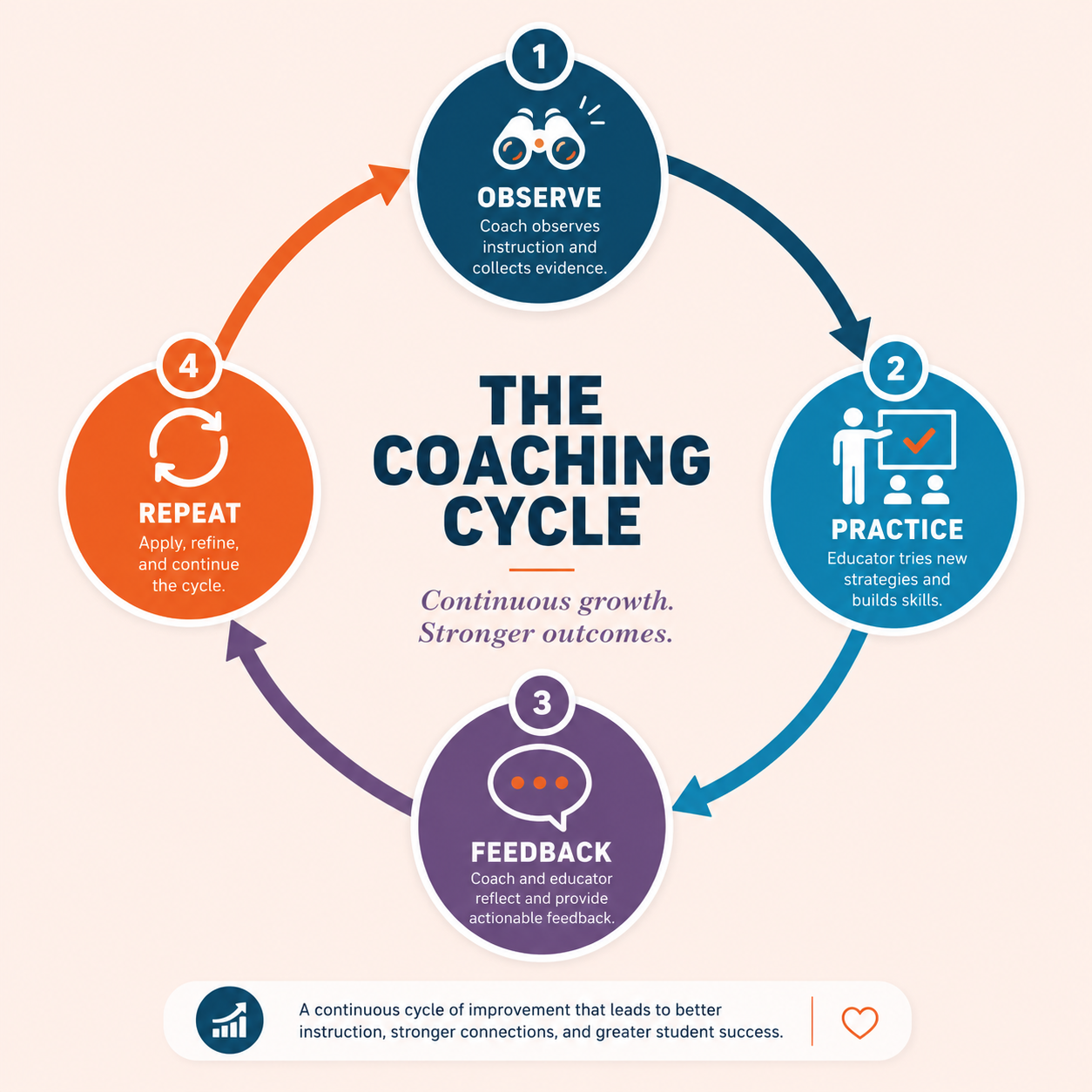
There are no slide decks. No best practice handouts. No "here's what research says you should do." What's there instead is a cycle — observe, feedback, practice, repeat — grounded in what's actually happening in this teacher's classroom, oriented toward this teacher's goals.
The feedback piece matters especially. Matsumura and colleagues found that the quality and frequency of feedback was among the strongest predictors of coaching impact. Regular, specific, evidence-based feedback produced meaningfully greater improvements in practice than infrequent or loosely structured coaching interactions. And feedback here doesn't mean evaluation. It means a professional conversation — one grounded in real evidence, aimed at real growth, happening inside a relationship the teacher actually trusts.
A 2023 study by Artman-Meeker and colleagues dug even deeper — examining which specific coaching actions predicted teacher and student outcomes across 16 high-poverty charter schools.
The winner? Practice opportunities. When coaches gave teachers chances to actually practice new strategies during coaching sessions, teacher implementation and student achievement both improved — in ELA and math.
Feedback also predicted outcomes. Modeling — which is probably the most common coaching move — did not show a statistically significant effect on its own.
Sit with that for a second.
The thing coaches do most — demonstrate a strategy, show a teacher what it looks like — doesn't move the needle by itself. What moves the needle is letting teachers try it. With you. With feedback. That's the surgery, not the seminar.
Practice and feedback are the active ingredients. Everything else is scaffolding.
I want to say something directly to coaches, because I think it sometimes gets minimized in conversations about evidence and outcomes.
The relationship is the work.
Not a precondition for the work. Not a nice-to-have. The actual mechanism through which change happens.
Think about the teachers you've had the most impact with. I'd be willing to bet they're the ones who trusted you — who were honest about what wasn't working, who let you see the real mess of their classroom instead of performing competence for an observer. That's not a coincidence. That's causation.
Kraft, Blazar, and Hogan found teacher enthusiasm about coaching was a significant moderating variable. Teachers who were genuinely engaged — who had a positive relationship with their coach — showed measurably greater gains. The Dynamic Learning Project (Ronfeldt et al., 2020) extended this: teachers who experienced coaching as clearly non-evaluative were significantly more willing to take risks, share struggles honestly, and engage with feedback. When coaches got perceived as extensions of administrative oversight, the relationship degraded — and so did the coaching.
This creates a real structural problem that most schools haven't solved. Coaches are often hired by the principal, supervised by administrators, and exist somewhere in the murky middle between development and evaluation. The research says that structure works against the conditions that make coaching effective.
The most productive coaching relationships are ones where the teacher experiences you as a thinking partner. Not a spy. Not a soft evaluator. A colleague whose only job is their growth.
Protecting that clarity isn't a preference. It's a prerequisite.
Because it was never designed to change behavior. It was designed to deliver information.
There's a difference. A big one.
Learning Forward's Standards for Professional Learning are worth pulling out here — not as a compliance checklist, but because they describe what learning actually requires: active engagement, coherence with the teacher's real context, sustained duration, and collective participation oriented toward shared goals. A one-day workshop can't meet those standards. A training session, however expert the presenter, can't produce the kind of sustained behavioral change that improving teaching requires.
Coaching can. Because it's contextualized — happening in or adjacent to the actual classroom. Because it's sustained — not a single event but an ongoing relationship. Because it's active — the teacher is practicing and applying, not just receiving. Because it's individualized — calibrated to this person, in this classroom, with these students.
Joyce and Showers identified this decades ago. The combination of theory, demonstration, practice, and coaching produced far higher rates of transfer to classroom practice than any of those elements alone. Information transfer alone — which is what most PD amounts to — produces the lowest rates of behavioral change of any modality studied.
We've known this for a long time. We just keep doing the workshop anyway.
Because the word has been stretched so far, let me be direct about what I mean — and what the research means — when I use it.
Coaching is not a job title. It is not a meeting on a calendar. It is not a walkthrough with a conversation attached.
It is a structured, sustained, relationship-based professional practice. Grounded in evidence from the teacher's own classroom. Oriented toward the teacher's own goals. Built on trust that has to be earned and protected. Driven by practice and feedback, not demonstration and information.
When those conditions are present, the effects are real. When they're absent — when what we're calling coaching is really just supervision with better branding — the research is equally clear. The effects disappear.
That's the case for coaching. It's well-established, it's replicable, and it's stronger than the case for almost anything else schools invest in.
So why aren't more teachers receiving it?
That's the uncomfortable question. And the answer isn't a lack of belief in coaching. It's not usually a lack of willingness to invest. It's something more structural — something that lives at the intersection of time, scale, and the sheer complexity of doing this work well across a whole school or district.
The same research that makes the strongest case for coaching also reveals exactly why it so rarely reaches its potential. That's what the next post is about.
The stakes are too high to stop here.
.jpg)
While AI adoption is widespread in education, relying on AI detectors is failing and fueling an atmosphere of distrust. The deeper threat is "cognitive surrender"—where students lean on chatbots at the first sign of struggle—combined with a massive support gap for teachers who lack adequate guidance. Rather than policing students, the path forward involves focusing on active, observable learning processes, encouraging human connection, and giving educators collaborative tools like Sibme to reflect on and improve their teaching practice.

A university researcher's new argument about what gets lost when AI takes over parts of teaching turns out to be a preview of a debate we're already having about teacher coaching.

Schools can't just teach kids to understand AI — they have to teach kids to recognize their own agency in the relationship with it, because literacy alone won't settle the question this week's AI-safety debate couldn't.
The instructional evidence platform for K–12 districts.