Everyone is talking about AI. Fewer people are talking about what AI actually requires from the professional using it.
The current reality of AI-assisted lesson planning often involves a transactional exchange: a teacher enters a prompt, receives a generic plan. This approach prioritizes speed over depth, producing "cookie-cutter" instruction that lacks the nuance and personalization essential for effective teaching. Research on Technological Pedagogical Content Knowledge (TPACK) makes this plain: technology integration only works when the teacher's understanding of pedagogy and content guides the tool's use — not the other way around. When AI generates a lesson plan without deeply considering the pedagogical intent behind the content and method, the resulting plan may be technically complete and practically useless.
This is where a different kind of A and I becomes essential: Awareness + Intention.
Those are the other AI. And they matter just as much as the first one.
Awareness is what you bring to the output. Not passive consumption of what the model generated, but active recognition of what's actually in front of you — what it assumes, what it omits, what it got close to right. Evidence-first AI can dramatically accelerate awareness, because the evidence behind the output is right there, inspectable, not locked inside a black box. When a lesson plan surfaces alongside the student work samples and classroom recordings that shaped it, you can see the reasoning. You can agree with it, push back on it, revise it. The AI hasn't replaced your judgment. It's given your judgment something real to work with.
Intention is what no AI can supply. It's the professional deciding what this student needs, in this moment, given everything they know that didn't make it into the prompt. Intention is irreducibly human. It's the difference between a tool that informs a decision and a tool that makes one.
To put it simply:
Here's an example. If I'm coaching a new teacher on classroom management, what I'm looking for might be evidence of clear systems and routines. To find that evidence, I might look at the posters on the wall, the way students transition between activities, the cues the teacher gives.
In practice, humans tend to collapse these two moves into one — and that's where problems creep in. We often skip clearly defining what we're looking for before we start looking at things, which means our awareness ends up driving our intention rather than the other way around. We notice a problem and immediately start solving it. That instinct is part of what makes educators good at their jobs. It's also part of what burns them out.
Human memory is uneven. When awareness is built on memory, it becomes uneven too — we over-index on what was dramatic or recent, and we miss what was quiet or slow-developing. This is precisely why an AI-first approach to awareness, paired with a human-first approach to intention, works better than either alone.
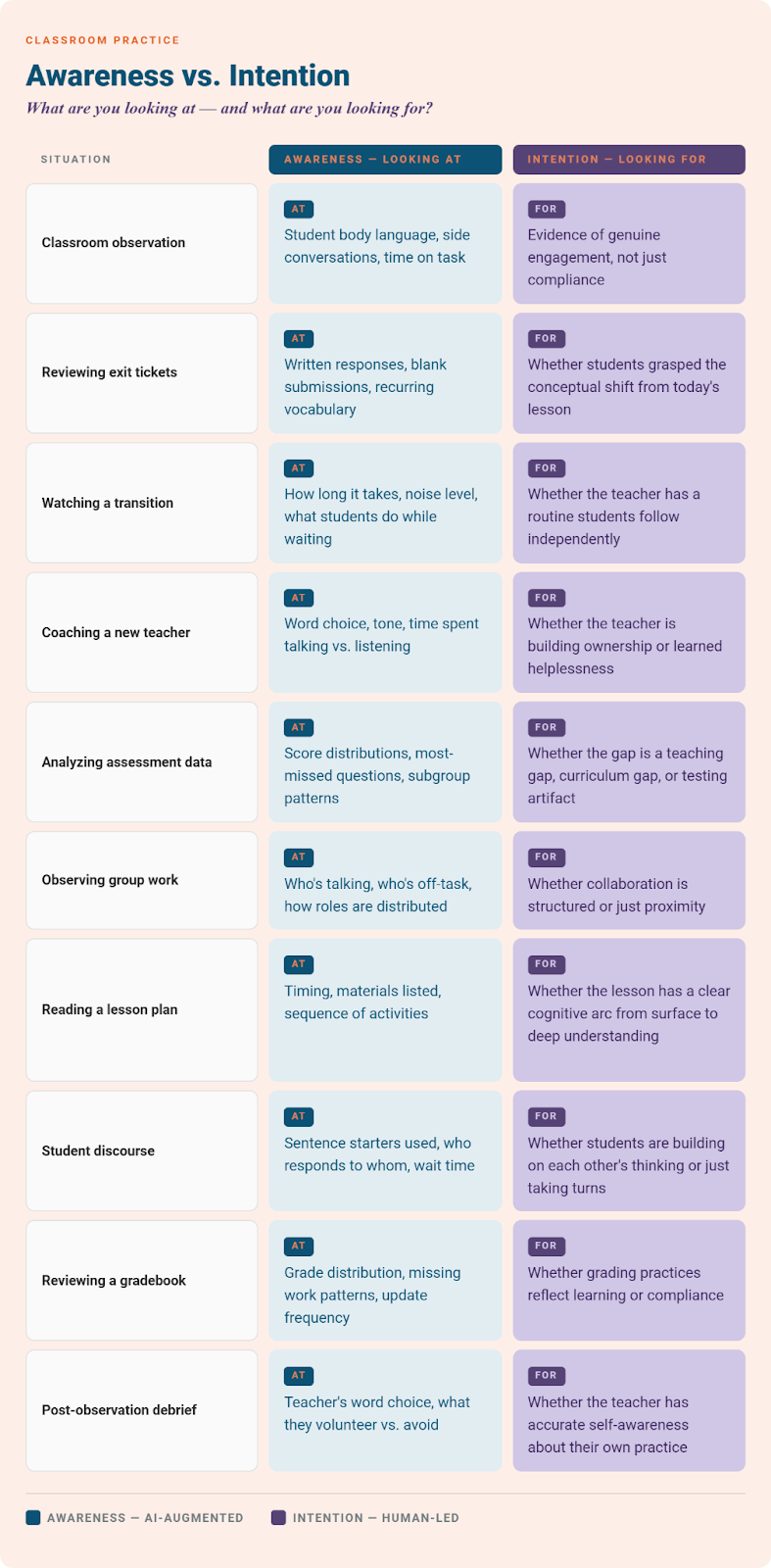
Consider two scenarios from a coaching context.
In the first, a coach has no pre-set goal when walking into an observation. In this case, the job is to become a data collector — capturing recordings, photos of bulletin boards, scans of exit tickets — without yet deciding what it all means. The interpretation comes later. AI accelerates this phase: given a clear framework, it can surface relevant moments from video, flag patterns in student work, point to evidence the coach might have missed. The coach then steps back in to develop intention for the teacher. This sequence works just as well for a teacher reflecting on their own practice as it does for a formal coaching cycle.
In the second scenario, the coach and teacher have already been working together for some time and have an agreed-upon goal. Here, intention precedes the observation. But the practical failure of most coaching cycles isn't in setting goals — it's that awareness isn't disciplined by those goals. We walk in with intention and still notice everything else. AI, in this case, can serve less as curator and more as guide — helping the coach and teacher decide together what to look at in advance, grounded specifically in that individual classroom and that specific goal. This isn't about creating generic "look-fors." It's closer to what Justin Baeder and Heather Bell Williams describe as mapping professional practice: hyper-specific, non-judgmental, designed to capture current reality rather than render a verdict.
The promise of AI in education isn't that it makes decisions faster. It's that it can expand our awareness in ways that make our intentions more precise and more honest. The risk is that we skip the awareness step entirely — that we hand the tool a vague prompt and accept the output as if it were the judgment we were supposed to bring ourselves.
The professionals who will use AI most effectively aren't the ones who learn to prompt better. They're the ones who stay clear about which part of the work belongs to the machine and which part belongs to them. Awareness can be augmented. Intention cannot be outsourced.
That's the other AI worth developing.
.jpg)
While AI adoption is widespread in education, relying on AI detectors is failing and fueling an atmosphere of distrust. The deeper threat is "cognitive surrender"—where students lean on chatbots at the first sign of struggle—combined with a massive support gap for teachers who lack adequate guidance. Rather than policing students, the path forward involves focusing on active, observable learning processes, encouraging human connection, and giving educators collaborative tools like Sibme to reflect on and improve their teaching practice.

A university researcher's new argument about what gets lost when AI takes over parts of teaching turns out to be a preview of a debate we're already having about teacher coaching.

Schools can't just teach kids to understand AI — they have to teach kids to recognize their own agency in the relationship with it, because literacy alone won't settle the question this week's AI-safety debate couldn't.
The instructional evidence platform for K–12 districts.